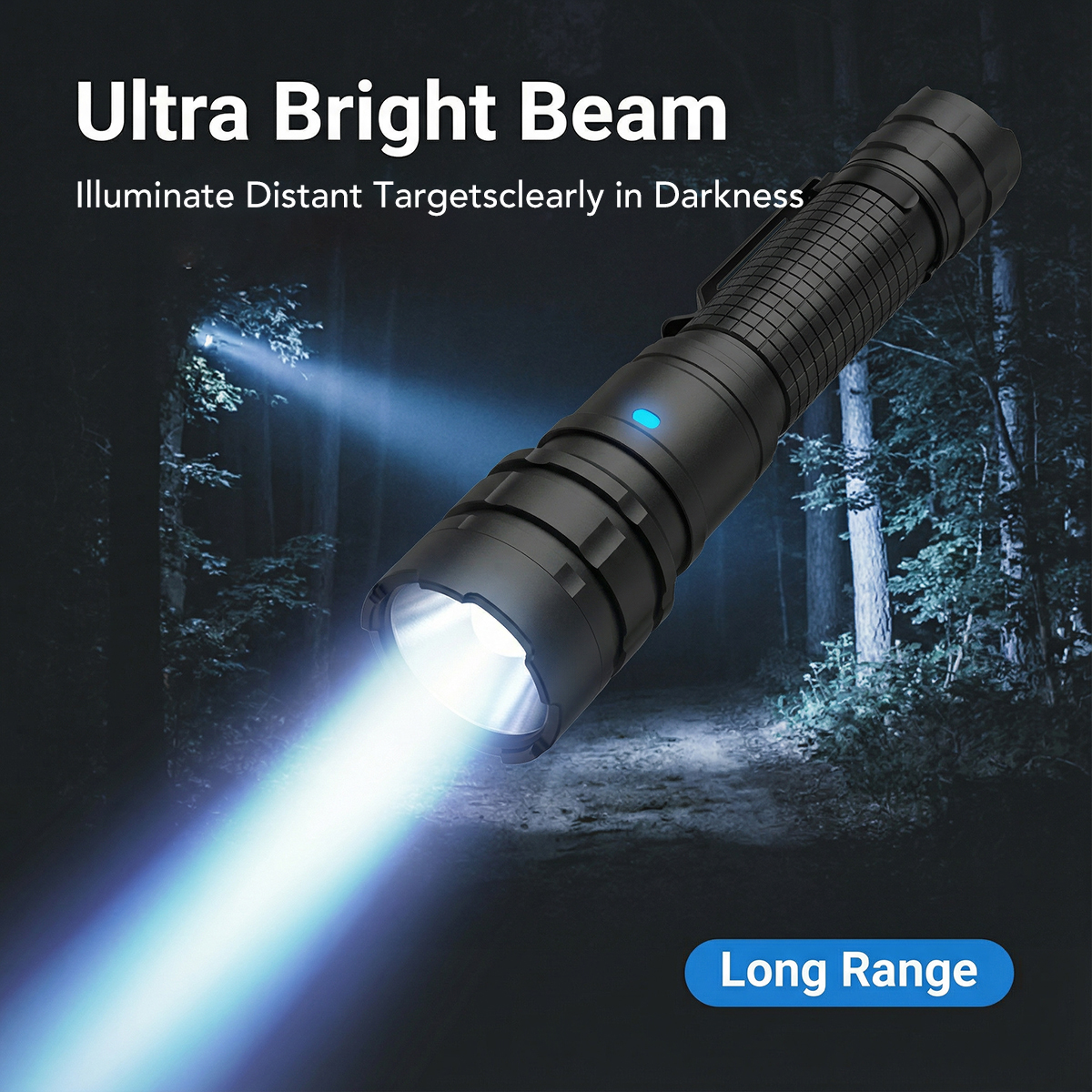

Waarom zaklampspecificaties zoveel verwarring veroorzaken
Zaklampproductpagina's plaatsen vaak het grootste lumennummer in het midden van het specificatieblad. Deze presentatie moedigt een eenvoudige aanname aan: meer lumen moeten betekenen dat je een fellere, krachtigere en langer werpende zaklamp hebt. De natuurkunde erachterZaklamp Lumens versus Candelalaat zien waarom die aanname onvolledig is.
Een zaklamp die een grote hoeveelheid licht produceert, kan dat vermogen over een groot nabijgelegen gebied verspreiden. Een andere zaklamp met een lagere totale opbrengst kan meer van zijn licht concentreren in een kleinere centrale hotspot. Op korte afstand kan het eerste product helderder lijken omdat het meer grond verlicht. Op lange afstand kan de tweede aanzienlijk meer bruikbaar licht op een ver doel plaatsen.
Dit verschil verklaart waarom een compacte tactische zaklamp met hoge candela beter kan presteren dan een grotere hoog-lumen floodlight tijdens inspectie van de perimeter, terwijl de floodlight nuttiger blijft voor een camping, werkplaats, onderhoudsruimte of binnennoodgeval. Geen van beide ontwerpen is universeel superieur. Elk bundelprofiel is geoptimaliseerd voor een andere taak.
Een professionele vergelijking vereist daarom meer dan één specificatie. Lumens beschrijven de totale zichtbare output. Candela beschrijft intensiteit in een bepaalde richting. Lux beschrijft hoeveel licht een bepaald oppervlak bereikt. Straalafstand zet piekintensiteit om in een gestandaardiseerde theoretische afstand. De gebruikerservaring hangt ook af van hotspotgrootte, overstromingsintensiteit, optische uitlijning, runtime, thermische stepdown, kleurtemperatuur en omgevingscondities.
Het doel van een technischeZaklamp Lumens versus Candelavergelijken is niet om te bepalen welke eenheid "beter" is. Het is bedoeld om te bepalen of het optische systeem het beschikbare licht naar de plek stuurt waar de eindgebruiker het nodig heeft.
Lumens in een zaklamp Lumens vs Candela Vergelijking
Lumens meten de lichtstroom: de totale hoeveelheid zichtbaar licht die door een bron of lichtsysteem wordt uitgezonden. In praktische zaklamptaal geven lumens aan hoeveel zichtbaar licht het product verlaat, maar ze specificeren niet waar dat licht naartoe gaat.
Stel je voor dat je dezelfde hoeveelheid water door twee verschillende sproeikoppen giet. Eén nozzle creëert een brede straal; de andere creëert een smalle straal. Het totale watervolume kan vergelijkbaar zijn, maar de verdeling en het bereik zijn verschillend. Zaklampoptiek werkt op een vergelijkbare manier. Twee producten met dezelfde lumenoutput kunnen dramatisch verschillende bundelprofielen produceren.
Een hoog-lumen floodlight kan zijn vermogen verdelen in een brede hotspot en brede overstroming. Dit is nuttig voor situationeel bewustzijn, kamerverlichting, bouwwerk, onderhoud of verlichting van kampeerplaatsen. Een werper kan een kleiner deel van zijn output richten op perifere lekkage terwijl hij meer energie concentreert in een smalle hotspot die verder weg zichtbaar blijft.
Daarom kan lumens alleen deZaklamp Lumens versus CandelaVraag. Lumens beschrijven de totale hoeveelheid licht, niet de hoekconcentratie van dat licht.
Niet elke lumenfiguur betekent hetzelfde
Commerciële productcommunicatie kan verwijzen naar verschillende outputwaarden:
- LED-behuizingsuitgang:een componentniveauwaarde geregistreerd onder gespecificeerde laboratoriumomstandigheden.
- Uit-de-voor-uitvoer:licht gemeten na verlies door de reflector, lens, voorruit en de volledige zaklampstructuur.
- Opstartpiek:de hoogste output direct na activatie.
- Aanhoudende output:het niveau dat na de driver en het thermische besturingssysteem wordt gehandhaafd, vermindert de initiële piek.
Deze cijfers zijn niet uitwisselbaar. Reflectorefficiëntie, lenstransmissie, bestuurdersefficiëntie, batterijspanning, LED-temperatuur, voorruitcoating en thermische regeling beïnvloeden de output die de omgeving bereikt.
Een zaklamp die alleen met een startpiek wordt geadverteerd, kan die waarde voor een beperkte periode leveren voordat hij wordt teruggeschroefd om de LED, batterij, elektronische driver, behuizing en gebruiker te beschermen. Voor B2B-kopers moet een volledige evaluatie een outputcurve bevatten of ten minste een duidelijke aangaf van hoe lang de maximale modus wordt gehandhaafd.
Hogere lumen moeten niet automatisch als hogere kwaliteit worden beschouwd. Een succesvol ontwerp balanceert de lichtstroom met bundelverdeling, draaitijd, warmtebeheer, productgrootte, elektrische efficiëntie en de daadwerkelijke toepassing.
Candela: Richtingsbundelintensiteit
Candela meet de lichtintensiteit in een bepaalde richting. Voor zaklampen verwijst piekcandela normaal gesproken naar de hoogste intensiteit die in het midden van de bundel wordt gemeten. Dit is de parameter die het meest geassocieerd wordt met langeafstandsworp.
Binnen deZaklamp Lumens versus Candelarelatie, Candela beantwoordt een andere vraag dan Lumens. Lumens vraagt: "Hoeveel zichtbaar licht produceert de zaklamp?" Candela vraagt: "Hoe intens is dat licht geconcentreerd in de sterkste richting?"
Een hoge candelawaarde geeft aan dat het optische systeem een betekenisvolle hoeveelheid licht concentreert in een relatief klein hoekgebied. Het betekent niet dat de zaklamp meer totaal licht produceert, en het betekent niet dat de overstroming groter is. Een zaklamp met hoge candela kan een matige totale lumen hebben terwijl het een zichtbare hotspot over een aanzienlijke afstand produceert.
Wat veroorzaakt een hoge piekstraalintensiteit?
LED's met een klein emitterende oppervlak gecombineerd met diepe reflectoren worden vaak gekozen voor de engineering van langeafstandszaklampen. Grotere multi-die-emitters kunnen meer totale lumen produceren, maar hun grotere emitterende oppervlak kan extreme optische collimatie bemoeilijken.
Hoge candela brengt ook afwegingen met zich mee. Een sterk geconcentreerde straal kan een uitstekende reikwijdte bieden, maar beperkte perifere waarneming. Op korte afstand kan een intense hotspot schittering veroorzaken, het visuele comfort verminderen en details buiten het bundelcentrum verbergen. Candela moet daarom worden afgestemd op de operationele omgeving in plaats van gemaximaliseerd zonder context.
Een technisch betekenisvolleZaklamp Lumens versus CandelaDe evaluatie houdt rekening met de intensiteit van hotspots en overstroming samen. Een ver weg doelwit heeft mogelijk een geconcentreerde hotspot nodig, terwijl de gebruiker nog genoeg overstroming nodig heeft om het nabijgelegen terrein en de beweging te begrijpen.
Lux en de omgekeerde kwadraatrelatie
Lux meet de verlichtingskracht: de lichtstroom die per oppervlakte-eenheid op een oppervlak wordt ontvangen. Terwijl lumens het totaal uitgezonden licht beschrijven en candela de richtingsintensiteit beschrijft, beschrijft lux wat daadwerkelijk bij het doel aankomt.
Lux verbindt dus deZaklamp Lumens versus CandelaDiscussie tot echte doelverlichting. Ingenieurs kunnen luxmetingen gebruiken om te beoordelen hoeveel licht een muur, wegdek, inspectiegebied of ver object bereikt.
Verlichting is sterk afhankelijk van afstand. Naarmate de bundel naar buiten reist, verspreidt de energie zich over een groter gebied, waardoor de lux bij het doel afneemt.
E = I / d²
Deze formule illustreert de inverse kwadraatrelatie. Als de afstand verdubbelt, daalt de verlichting tot ongeveer een kwart, uitgaande van dezelfde bundelintensiteit en geïdealiseerde omstandigheden. Als de afstand verdrievoudigt, daalt de verlichting tot ongeveer een negende.
Een bundel die bijvoorbeeld 100 lux aflevert op een bepaald punt zou theoretisch ongeveer 25 lux op twee keer zoveel afstand leveren. Deze snelle vermindering verklaart waarom zaklampen voor lange afstand een aanzienlijke piekbundelintensiteit nodig hebben om betekenisvolle doelverlichting te behouden.
Echte metingen vereisen een gecontroleerde opstelling. De luxmeter moet consequent in het bundelcentrum worden geplaatst, afstand moet nauwkeurig worden gemeten, omgevingslicht moet worden gecontroleerd en de zaklamp moet stabiel blijven. Acculading, bedrijfsmodus, LED-temperatuur en thermische stepdown beïnvloeden ook het resultaat.
Luxfiguren die op verschillende afstanden zijn vastgelegd, kunnen niet direct worden vergeleken zonder conversie. Een leverancier die een luxwaarde opgeeft zonder de meetafstand te vermelden, heeft onvolledige informatie verstrekt.
Hoe de bundelafstand van zaklampen wordt berekend
Straalafstand is een van de meest verkeerd begrepen resultaten in eenZaklamp Lumens versus CandelaVergelijking. Het moet niet worden geïnterpreteerd als de verste afstand waarop iemand een zwak spoor van licht kan waarnemen.
Een veelgebruikte FL 1-berekening bepaalt de afstand waarop de piekverlichting daalt tot 0,25 lux. Dit creëert een herhaalbare referentie voor het vergelijken van zaklampontwerpen.
d = √(I / 0,25)
De drempel van 0,25 lux is een laag verlichtingsniveau. Het biedt een wiskundig eindpunt, maar garandeert geen zelfverzekerde doelidentificatie, kleurherkenning, visueel comfort of veilige operationele prestaties op de opgegeven afstand.
De daadwerkelijke zichtbaarheid kan worden verminderd door mist, regen, vochtigheid, stof, rook, luchtdeeltjes, straatverlichting, koplampen van voertuigen, doelkleur, reflectie van het doel en het zicht van de waarnemer. Een reflecterend verkeersbord kan zichtbaar blijven nabij de berekende afstand, terwijl een persoon, dier of mat object met weinig contrast veel eerder moeilijk te herkennen kan zijn.
Professionele kopers moeten onderscheid maken tussen theoretische bundelafstand, detectieafstand, herkenningsafstand en identificatieafstand. Deze termen beschrijven verschillende niveaus van visuele informatie.
Straalfoto's zijn ook een onbetrouwbare vervanging voor gecontroleerde metingen. Camerabelichting, diafragma, ISO-gevoeligheid, witbalans, brandpuntsafstand, beeldverwerking en atmosferische omstandigheden kunnen de ene zaklamp veel sterker laten lijken dan de andere.
Het bundelafstandsresultaat is nuttig, maar alleen wanneer het binnen de volledige wordt geïnterpreteerdZaklamp Lumens versus Candelakader.
Optische techniek achter zaklampwerp
Langeafstandszaklamptechniek is een discipline op systeemniveau. De LED, reflector of lens, voorruit, driver, thermisch pad, behuizing, afdichtingsstructuur en assemblagetolerantie moeten samenwerken. Het optimaliseren van slechts één component levert zelden een stabiele productieklare bundel op.
De techniek achterZaklamp Lumens versus Candelabegint met het lichtuitstralende oppervlak en loopt door elk onderdeel dat licht aanstuurt of absorbeert.
LED-lichtgevend oppervlak
De grootte en vorm van het LED-emitterende oppervlak beïnvloeden direct de collimatie. Een kleiner emitterend oppervlak kan over het algemeen worden geprojecteerd in een strakkere hoekbundel. Dit is een van de redenen waarom bepaalde compacte, intensieve LED's populair zijn voor werpers.
Grotere emitterende oppervlakken kunnen een aanzienlijke totale output en brede verlichting ondersteunen, maar ze zijn moeilijker te focussen in een extreem kleine hotspot. LED-elektrische voeding alleen bepaalt niet de bundelafstand. Emitterluminantie, chipgeometrie, fosforeigenschappen, driverstroom, optische efficiëntie en bedrijfstemperatuur zijn allemaal van belang.
Reflectordiameter en -diepte
Een reflector verzamelt licht dat de LED onder verschillende hoeken verlaat en leidt een deel ervan naar de optische as. Een grotere diameter vergroot de optische opening, terwijl extra diepte kan helpen om meer laterale stralen te beheersen. Wanneer correct ontworpen, kan een grote en diepe reflector een smallere en intensere hotspot creëren.
De grootte van de reflector alleen garandeert geen betere prestaties. De brandpuntspositie moet overeenkomen met de LED. Oppervlaktekwaliteit, reflectorprofiel, coatingkwaliteit, vooropening, LED-centrering, bezelgeometrie en productietolerantie beïnvloeden ook de bundel.
Een grotere kop kan de candela vergroten, maar het verhoogt ook het productvolume en het gewicht. Dit kan acceptabel zijn voor een professionele zoeklamp, maar ongeschikt voor een EDC-zaklamp bedoeld voor het dragen in zakken.
SMO- en OP-reflectoren
Een glad, spiegelachtig oppervlak ondersteunt een geconcentreerde hotspot en wordt veel gebruikt in langeafstandsontwerpen. Het kan ook fouten in het centreren van de emitter, ringen, tintvariatie of oppervlakdefecten duidelijker aan het licht brengen.
Een sinaasappelschiltextuur zorgt voor gecontroleerde diffusie die overgangen verzacht en zichtbare ringen vermindert. Het wordt vaak geselecteerd voor EDC, werk op korte afstand en algemene buitenverlichting.
TIR Optica
Totale interne reflectie-optiek gebruikt breking en interne reflectie om licht binnen een compact optisch component te beheersen. Een TIR kan een soepele overgang creëren tussen hotspot en overloop en wordt veel gebruikt in EDC-zaklampen, koplampen en producten die aangepaste bundelhoeken vereisen.
Verschillende TIR-geometrieën kunnen smalle, middelgrote, elliptische of brede bundelpatronen creëren. Een TIR is niet automatisch een flood optic of throw optic. Het gedrag hangt af van ontwerphoek, materiaal, oppervlaktebehandeling, emittercompatibiliteit en mechanische positionering.
LED en optische uitlijning
De LED moet dicht bij het optische brandpunt worden geplaatst. Kleine laterale of verticale fouten kunnen een oneffen hotspot, off-axis bundel, ringen, een donker middengebied, asymmetrische overstroming of verminderde candela veroorzaken.
Productieconsistentie is daarom zowel een mechanische als een optische uitdaging. CNC-toleranties, printplaatdikte, plaatsing van de LED-printplaat, afmetingen van de centeringring, reflectorzitting, pakkingcompressie en koppel van de bezel kunnen de optische relatie verschuiven.
Een prototype met uitstekendeZaklamp Lumens versus CandelaPrestaties garanderen geen consistente massaproductie, tenzij deze variabelen worden gecontroleerd via gedocumenteerde productie- en inspectieprocedures.
Vergelijkingstabel zaklamp Lumens vs Candela
Het volgendeZaklamp Lumens versus CandelaTable vergelijkt vier balkstrategieën. Het richt zich op technische prioriteiten in plaats van het presenteren van vaste lumen- of candela-bereiken die niet uniform gelden voor verschillende productgroottes, emitters, optische systemen en markten.
| Producttype | Typische ontwerpprioriteit | Lumen-strategie | Candela-strategie | Straalpatroon | Optische structuur | Praktische Sterkte | Belangrijkste beperking | Typische toepassingen |
|---|---|---|---|---|---|---|---|---|
| High-Lumen Floodlight | Maximale verlichting in het nabijgelegen gebied | Hoge lichtstroom breed verdeeld | Secundair aan breedte en uniformiteit van de bundel | Brede hotspot en sterke overstroming | Breed TIR, ondiepe reflector, multi-emitter of COB-systeem | Uitstekende situationeel inzicht op korte afstand | Beperkte intensiteit op lange afstand en hogere thermische belasting | Werkplaatsen, kampeerplaatsen, binnenruimtes, verlichting voor noodgebieden |
| Gebalanceerde EDC-zaklamp | Draagbaar en veelzijdig dagelijks gebruik | Matige tot hoge output met bruikbare runtime | Gebalanceerd voor zicht op de korte en middenlange afstand | Gedefinieerde hotspot met praktische overstroming | Compacte TIR of OP-reflector | Nuttig bij een breed scala aan routinetaken | Kan extreme flood en extreme throw niet tegelijkertijd maximaliseren | Dagelijkse vervoer, onderhoud, voertuigen, algemeen buitengebruik |
| High-Candela Tactische Werper | Langeafstandsbelichting van doelen | Voldoende totale output om een intense hotspot te ondersteunen | De maximale bundelintensiteit is een primair doel | Nauwe hotspot met gecontroleerde overstroming | LED met een klein emitterende oppervlak en diepe SMO-reflector | Sterk bereik en weerstand tegen uitspoeling door omgevingslicht | Smaller veld en mogelijke schittering van dichtbij | Beveiliging, doorzoeking, perimeterinspectie, buitenobservatie |
| Breedstraalkoplamp | Comfortabel handsfree nabij-veld verlichting | Gecontroleerde output voor runtime en thermisch comfort | Meestal een lagere prioriteit dan bundeluniformiteit | Brede en soepele nabijveldverlichting | Groothoek-TIR, diffuser, COB of gemengd-bundelsysteem | Natuurlijke zichtbaarheid voor beweging en handsfree werk | Beperkte afstandsidentificatie | Wandelen, reparatiewerk, industriële taken, kamperen |
Applicatiegebaseerde bundelselectie
De praktische waarde vanZaklamp Lumens versus Candelawordt duidelijker wanneer de vereiste bundel wordt afgestemd op een echte operationele taak. Een nuttige zaklamp balanceert intensiteit, breedte, looptijd, ergonomie, thermisch gedrag en omgevingsomstandigheden.
Zoek- en Reddingsactie
Zoekteams hebben betekenisvolle worp nodig gecombineerd met genoeg overstroming om situationeel bewustzijn te behouden. Een extreem smalle potloodstraal kan reflecterende objecten lokaliseren, maar kan terreingevaren buiten de hotspot verbergen.
Perimeterbeveiliging
Beveiligingswerk geeft prioriteit aan afstandsherkenning en het vermogen om matig omgevingslicht te overwinnen. Hoge candela is waardevol, maar de overstroming moet voldoende zijn om beweging rond het centrale doel te volgen.
Jacht en Buitenobservatie
Doelherkenning, stabiele output, straalhelderheid en geschikte kleurtemperatuur zijn van belang. Overmatige schittering, tintverschuiving of een extreem smalle straal kan het praktische bewustzijn in complex terrein verminderen.
EDC
Dagelijks dragen geeft de voorkeur aan een compact lichaam, soepele verlichting in het nabij- tot middenbereik, beheersbare warmte, handige bediening en een nuttige overloop. Maximale worp is meestal minder belangrijk dan veelzijdigheid.
Industriële inspectie
Inspectietaken vereisen vaak gecontroleerde lux op korte afstand, vermindering van schittering, uniforme verlichting en geschikte kleurweergave. Een geconcentreerde hotspot kan details op reflecterende oppervlakken verbergen.
Koplampen
Koplampen geven prioriteit aan brede, comfortabele verlichting, gewichtsbalans, gebruiksduur en minder tunnelvisie. Een gemengde straal kan het bereik vergroten zonder het zicht op het nabije veld in te leveren.
Hoe 1.900 lumens 626 meter kunnen bereiken
De SHENGQI LIGHTING T1-PRO biedt een nuttig voorbeeld van een echt product vanZaklamp Lumens versus Candela. Hij is gepositioneerd als een professionele langeafstandstactische zaklamp met een maximale output van 1.900 lumen en een opgegeven bundelafstand van 626 meter.
De beschikbare productinformatie identificeert een LUMINUS SFT40 LED, een kleurtemperatuurbereik van 6500K–7500K, een 6063 aluminiumlegering body, IP68-bescherming en een impactbestendigheid van één meter. De zaklamp gebruikt een diepe reflector om een geconcentreerde langeafstandsbundel te vormen.
De opgegeven afstand van 626 meter wordt niet alleen door 1.900 lumen gecreëerd. De SFT40 heeft een relatief geconcentreerd lichtuitgevend oppervlak dat geschikt is voor directionele optica. De diepe reflector verzamelt en leidt licht om naar de optische as. Het reflectorprofiel, de hoogte van de emitter, het centreercomponent, de vooropening en de mechanische uitlijning beïnvloeden de uiteindelijke piekintensiteit van de bundel.
In ditZaklamp Lumens versus CandelaIn het geval beschrijft de lumenfiguur de totale beschikbare zichtbare output. Candela bepaalt of genoeg van die output in de hotspot wordt geconcentreerd om op afstand bruikbaar te blijven.
Een floodlight van 1.900 lumen met een ondiepe optic kan een groot nabijgelegen gebied verlichten en tegelijkertijd een veel kortere worpafstand opleveren. Een correct uitgelijnd langeafstandssysteem kan hetzelfde algemene lumenniveau gebruiken om aanzienlijk grotere centrale intensiteit te produceren.
626² × 0,25 ≈ 97.969 cd
Op basis van de opgegeven bundelafstand van 626 meter en de formule van 0,25 lux is de theoretische piekbundelintensiteit ongeveer 98.000 candela. Deze figuur is een wiskundige schatting afgeleid van de opgegeven bundelafstand. Het is geen onafhankelijk aangeleverde officiële productparameter en mag niet worden gepresenteerd als een niet-geverifieerd testresultaat.
Langeafstandstechniek vereist ook compromissen die niet in de bundelafstandformule voorkomen. Een diepere of bredere kop vergroot de productgrootte. Een hogere aandrijfstroom verhoogt de warmteproductie en kan de thermische afbouw versnellen. Een smalle hotspot verbetert het bereik, maar kan de bruikbaarheid in de buurt verminderen. Batterijcapaciteit, driverregeling, LED-temperatuur en gebruiksduur bepalen hoe lang de zaklamp bruikbaar kan blijven.
De T1-PRO kan worden geëvalueerd voor zoek- en reddingsacties, perimeterinspectie, buitenobservatie op lange afstand en professionele verlichtingsopdrachten. De technische waarde ligt in de gecoördineerde relatie tussen de emitter, diepe reflector, optische focus, mechanische uitlijning, thermisch pad en structurele bescherming.
Veelvoorkomende misvattingen over zaklampprestaties
Veel verkeerde aankoopbeslissingen ontstaan door het verminderenZaklamp Lumens versus Candelatot één enkel kopnummer. De volgende misvattingen moeten worden gecorrigeerd voordat er productkeuze of OEM-ontwikkeling plaatsvindt.
Hoe B2B-kopers de prestaties van zaklampen moeten verifiëren
Importeurs, distributeurs, productmanagers en OEM-sourcingteams moeten voldoende informatie opvragen om eenZaklamp Lumens versus Candelaclaim. Het doel is om mismatched verwachtingen te voorkomen tussen productontwikkeling, massaproductie, marketing en prestaties van eindgebruikers.
Bevestig of de lumenwaarde een opstartpiek is, een getimede meting of een aanhoudend outputniveau.
Vraag of de bundelafstand wordt berekend met de 0,25-lux referentie.
Vraag piekcandela of de lux-meting aan die wordt gebruikt om piekintensiteit af te leiden.
Noteer de meetafstand, de plaatsing van de meter, de stabilisatietijd en de testomgeving.
Controleer het accumodel, de opgegeven capaciteit, de laadtoestand en of er een interne of verwijderbare cel is gebruikt.
Bevestig het LED-model en het kleurtemperatuurbereik, want emittervarianten kunnen de uitgang en bundelkarakteristieken veranderen.
Bepaal of het model een SMO-reflector, OP-reflector, TIR-optiek, focuslens, diffuser of gemengd optisch systeem gebruikt.
Vraag hoe lang de maximale modus wordt gehandhaafd voordat de getimede of thermische uitgangsvermindering plaatsvindt.
Bekijk de logica van de temperatuurregeling en vraag of de output kan herstellen nadat de zaklamp is afgekoeld.
Vergelijk straalfoto's alleen wanneer belichting, afstand, camera-instellingen en doeloppervlakken consistent zijn.
Evalueer verschillende productiemonsters op hotspotpositie, tint, lekkaos, optische artefacten en outputconsistentie.
Zorg ervoor dat waterdichtheid en impactclassificaties gelden voor het exacte productmodel en de aankoopconfiguratie.
Vraag om monstertests, interne meetgegevens of ondersteunende rapporten wanneer prestaties commercieel kritisch zijn.
Hoe SHENGQI LIGHTING optische en OEM-ontwikkeling ondersteunt
Dongguan Shengqi Lighting Technology Co., Ltd., opererend onder het merk SHENGQI LIGHTING, heeft productie-wortels die teruggaan tot 1981. Het huidige bedrijf werd formeel opgericht in 2008 en richt zich op zaklampen, draagbare verlichting en OEM/ODM-productie.
De productielocatie beslaat ongeveer 130.000 vierkante voet en is uitgerust met 75 CNC-machines, één volledig geautomatiseerde SMT-productielijn, twee laslijnen en elf stofvrije assemblagelijnen. De jaarlijkse productiecapaciteit van zaklampen bedraagt ongeveer 2,2 miljoen eenheden.
Ontwikkelingsondersteuning omvat industrieel ontwerp, optisch technisch ontwerp, elektronisch ontwerp, verpakkingsontwerp, productie en testen. Beschikbare testmogelijkheden omvatten optische uitgang, schakelduur, trillingen, impact, temperatuur, hoge- en lagetemperatuuromgevingen, waterdichtheid en batterijevaluatie. Het bedrijf implementeert een ISO9001 kwaliteitsmanagementsysteem.
Voor een OEM-zaklampfabrikant,Zaklamp Lumens versus Candelakan niet los worden gescheiden van productie-uitvoering. Een reflectorprofiel kan correct presteren in een ontwerpmodel, maar CNC-toleranties, LED-positionering, printplaatafmetingen, centreercomponenten, pakkingcompressie, driverregeling en assemblageherhaalbaarheid bepalen of de beoogde bundel consistent in productie voorkomt.
OEM- en ODM-ontwikkeling moet beginnen met de vereiste toepassing: doelafstand, hotspotgrootte, overloopbreedte, runtime, thermische limieten, productafmetingen, milieubescherming en gebruikersinterface. De juiste oplossing kan een diepe SMO-reflector, een OP-reflector, een compacte TIR, een scherpstellens of een gemengde bundelconfiguratie gebruiken.
SHENGQI LIGHTING kan productteams ondersteunen vanaf het initiële straalobjectief en het structurele concept via optische matching, elektronische ontwikkeling, prototype-evaluatie, productie en massaproductietests. Het doel is niet alleen het selecteren van het hoogste lumengetal, maar ook het opbouwen van een bundelprofiel dat passend presteert in de beoogde markt.
Veelgestelde vragen over zaklamp Lumens versus Candela
1. Is candela belangrijker dan lumens in een zaklamp?
Candela is belangrijker wanneer langeafstandsbundelintensiteit de primaire vereiste is, maar het is niet universeel belangrijker dan lumen. In eenZaklamp Lumens versus CandelaVergelijking: lumens beschrijven de totale output terwijl candela de richtingsconcentratie beschrijft. Een perimeterbeveiligingslicht kan candela prioriteren, terwijl een werklamp of koplamp een brede lichtstroom kan geven. Kopers moeten beide waarden evalueren, inclusief gebruikstijd, hotspot-grootte, overstroming, thermische regulatie, kleurtemperatuur en de verwachte bedrijfsafstand.
2. Hoe wordt de afstand van de zaklampbundel berekend?
Een veelgebruikte methode berekent de afstand waarop de piekverlichting daalt tot 0,25 lux. De formule is d = √(I / 0,25), waarbij d de afstand in meters is en I de piekbundelintensiteit in candela. Het resultaat is een gestandaardiseerde theoretische vergelijkingswaarde, geen garantie voor doelidentificatie. Weer, omgevingslicht, atmosferische deeltjes, reflectiviteit van het doel, bundelbreedte en het zicht van de waarnemer kunnen de praktische detectie- of herkenningsafstand aanzienlijk verminderen.
3. Waarom kan een zaklamp met een lagere lumen verder werpen?
Een zaklamp met een lagere lumen kan verder werpen wanneer het optische systeem meer licht concentreert in een kleinere centrale hoek. Een compact emitterend oppervlak, diepe reflector, nauwkeurige brandpuntspositionering en precieze centrering kunnen een hoge piekcandela genereren, zelfs bij matige totale output. Een zaklamp met een hoger lumen kan zijn vermogen over een brede hotspot verspreiden en lekken, waardoor er meer nabijgelegen verlichting ontstaat maar op afstand minder intensiteit. Dit is het centrale technische onderscheid inZaklamp Lumens versus Candela.
4. Welk candela-niveau is geschikt voor een tactische zaklamp?
Er is geen enkele candelawaarde die geschikt is voor elke tactische toepassing. De vereiste intensiteit hangt af van de doelafstand, omgevingslicht, binnen- of buitengebruik, de grootte van de hotspot, de overstromingsvereisten en het visuele comfort van dichtbij. Een perimeterinspectie-zaklamp kan aanzienlijk meer piekintensiteit nodig hebben dan een binnenlamp. Kopers zouden de verwachte identificatieafstand en omgeving moeten definiëren, en vervolgens de aanhoudende output, hotspotbreedte, overstroming, bundelartefacten, runtime en thermisch gedrag evalueren in plaats van één universeel getal te kiezen.
5. Hoe moeten kopers lumen- en beam-distance claims verifiëren?
Kopers moeten de testmethode, meetafstand, batterijconditie, LED-model, kleurtemperatuur, bedrijfsmodus, piek candela, lumentiming en thermisch stepdowngedrag opvragen. Ze moeten bevestigen of het opgegeven bereik de 0,25-lux formule gebruikt en of waterdichtheid en impactwaarden van toepassing zijn op het exacte model. Verschillende samples moeten worden geëvalueerd op output, hotspot-uitlijning, tint, overloop, runtime en consistentie. Dit bewijs maakt eenZaklamp Lumens versus CandelaClaim commercieel betekenisvol.
Definitieve educatieve samenvatting
De relatie tussenZaklamp Lumens versus Candelais geen competitie tussen twee uitwisselbare helderheidsgetallen. Lumens beschrijven de totale lichtopbrengst. Candela beschrijft de richtingsintensiteit. Lux beschrijft de verlichting die een doeloppervlak bereikt. De bundelafstand zet piekintensiteit om in een gestandaardiseerde theoretische afstand gebaseerd op een lage verlichtingsdrempel.
Een nuttige zaklamp wordt gemaakt wanneer deze metingen de beoogde toepassing ondersteunen. Hoog-lumen floodlights zorgen voor zicht op het gebied. Hoog-candela werpers behouden de centrale intensiteit over de afstand. Gebalanceerde EDC-zaklampen combineren hotspot en spill. Koplampen geven prioriteit aan brede, comfortabele nabij-veld verlichting.
Voor productontwikkelaars en inkoopteams is de meest betrouwbare evaluatiemethode het definiëren van de operationele taak, het beoordelen van de optische architectuur, het verifiëren van meetomstandigheden, het onderzoeken van aanhoudende prestaties en het testen van productiemonsters.
Een completeZaklamp Lumens versus CandelaDe beoordeling erkent dat geen enkele specificatie optische techniek, thermisch beheer, structureel ontwerp, consistentie in de productie en toepassingsgebaseerde tests kan vervangen.
Ontwikkel een straalprofiel rond de echte applicatie
Productmanagers van verlichtingsmerken, ontwikkelaars van tactische apparatuur, bedrijven voor buitenproducten, importeurs, distributeurs en OEM/ODM-sourcingteams kunnen bundelobjectieven, LED- en optische matching, selectie van reflectoren of TIR, prototype-evaluatie en productieondersteuning bespreken met SHENGQI LIGHTING.
Een technisch gebalanceerdeZaklamp Lumens versus CandelaDe specificatie moet beginnen met de beoogde omgeving, de streefafstand, hotspotvereiste, overloopbreedte, runtime en productafmetingen.